Sandflower’s sonic vision flirts with the otherworldly. Electrified on every level – emotionally, physically, and chromatically – she immerses her audience into the kaleidoscopic mosaic she’s masterfully creating.

The curtains open, the lights dim, and Sandflower’s signature stage shades come off. It’s an intentional unmasking, a moment of brief protection surrendered before a crowd of music lovers ready to dance, let go, and leap into another quantum with their radiant leader. That’s the Sandflower experience.
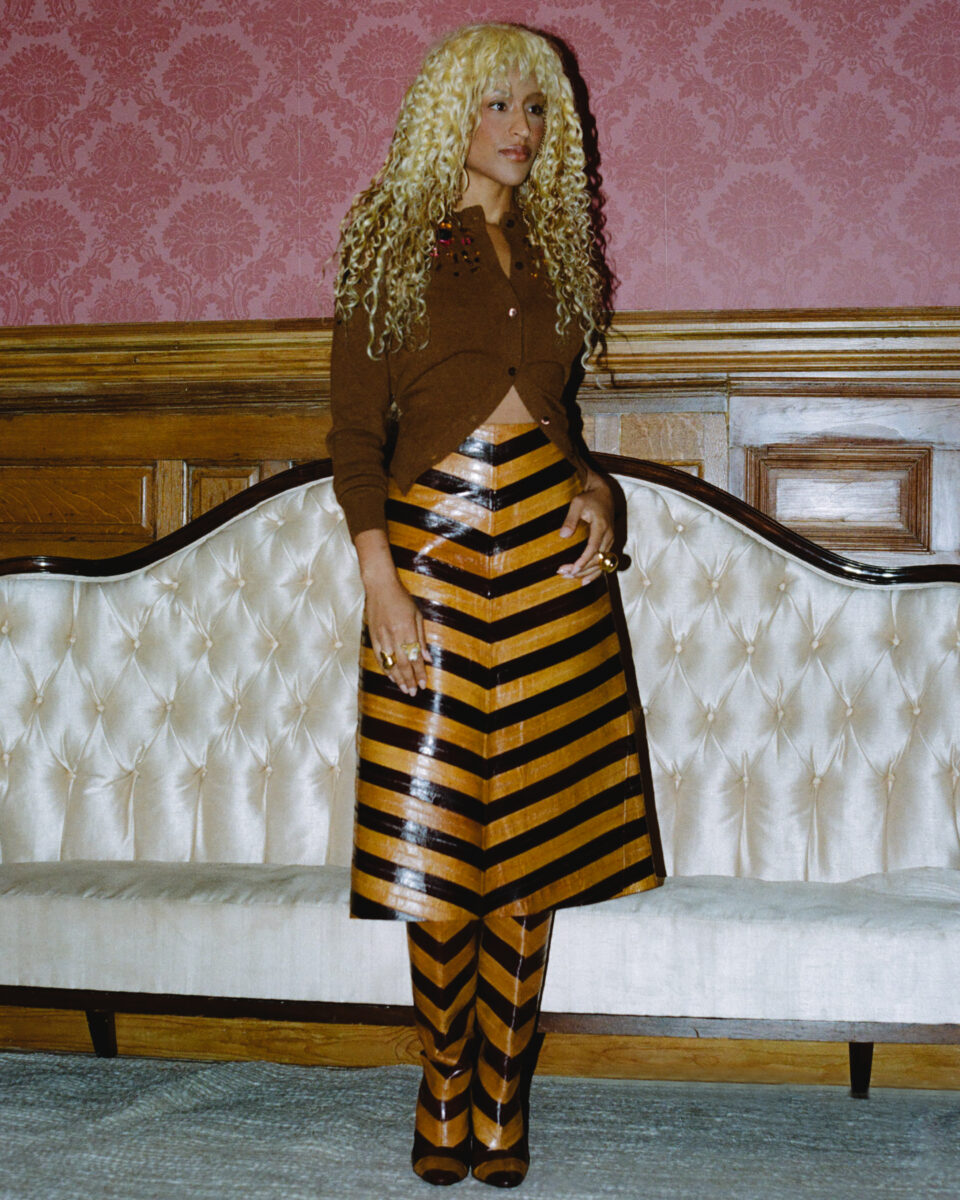
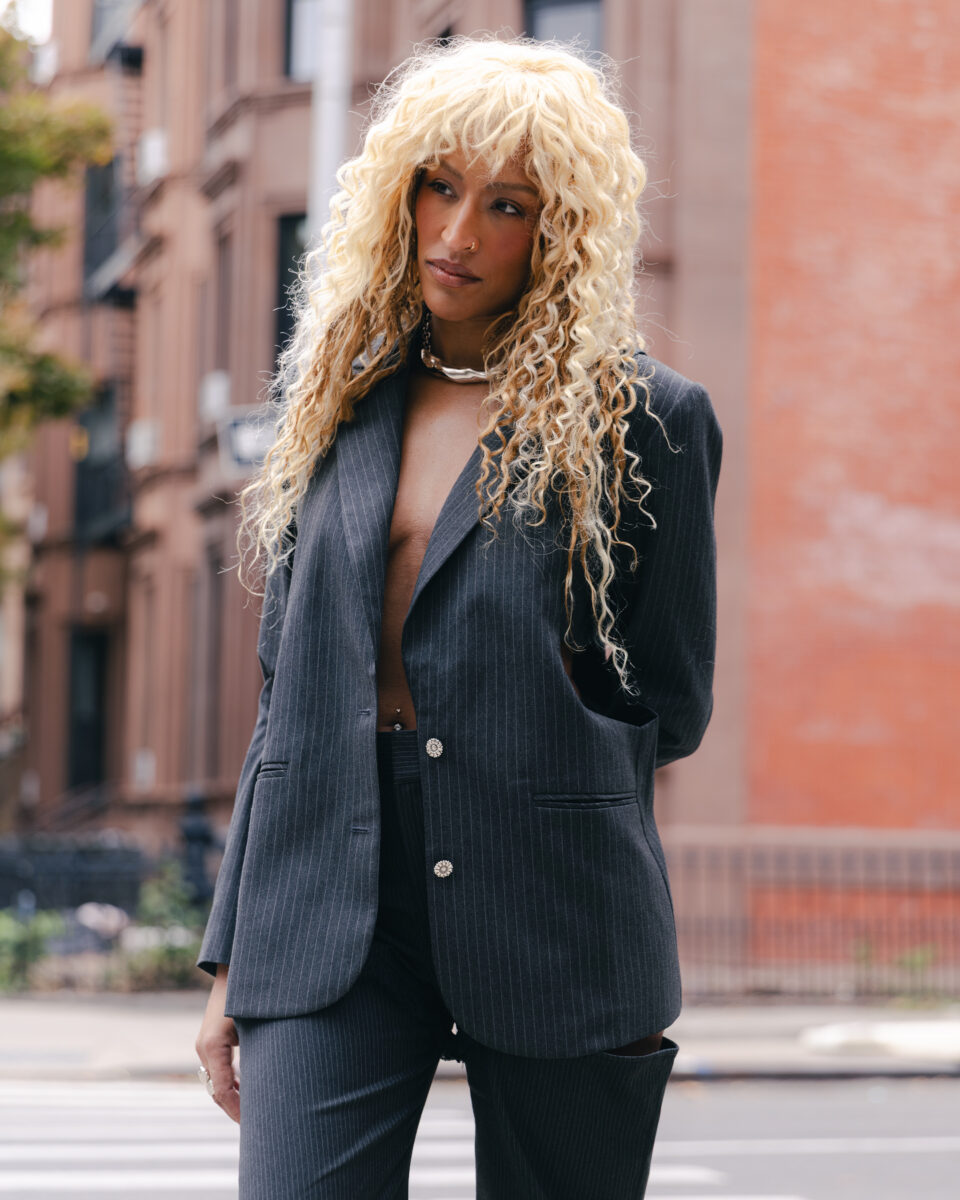
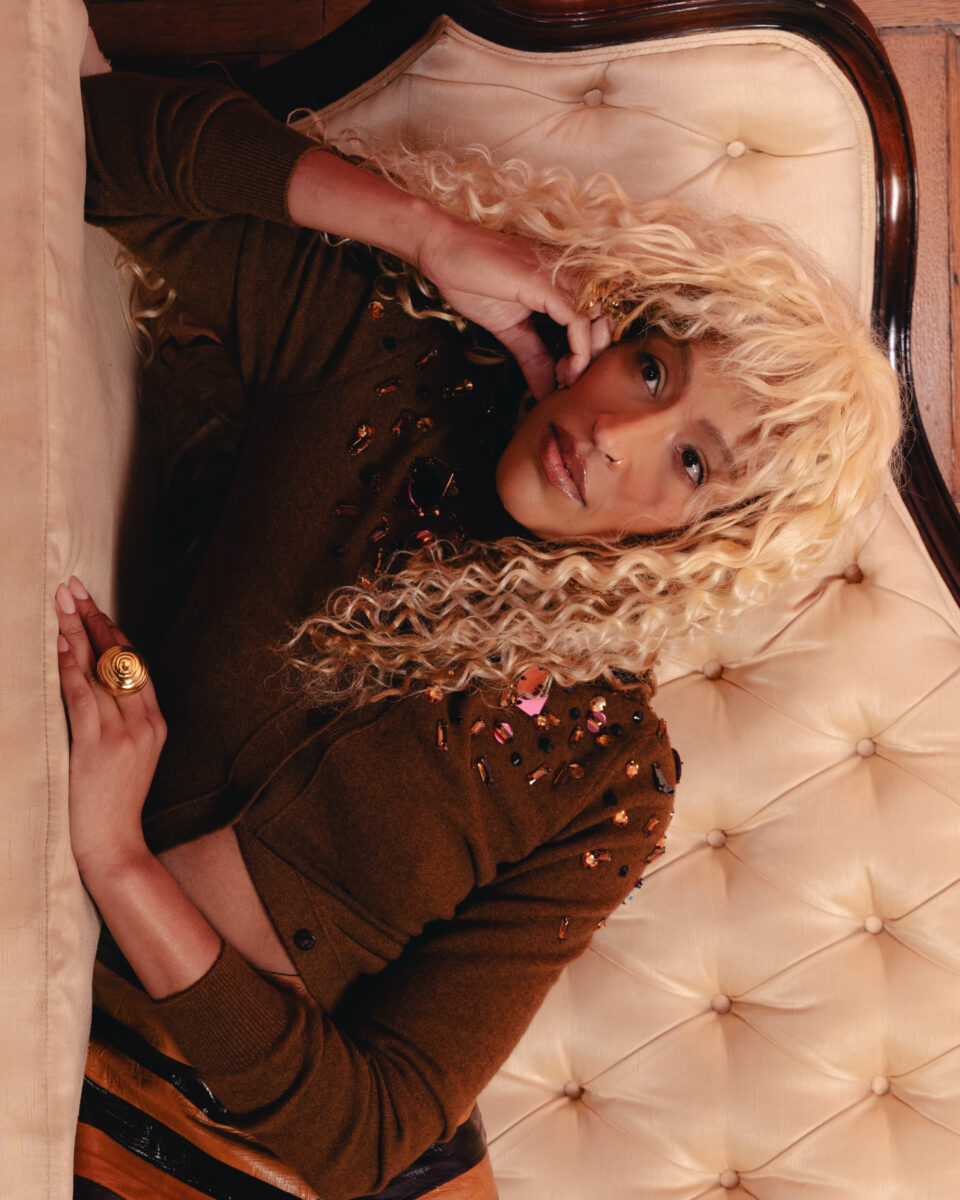
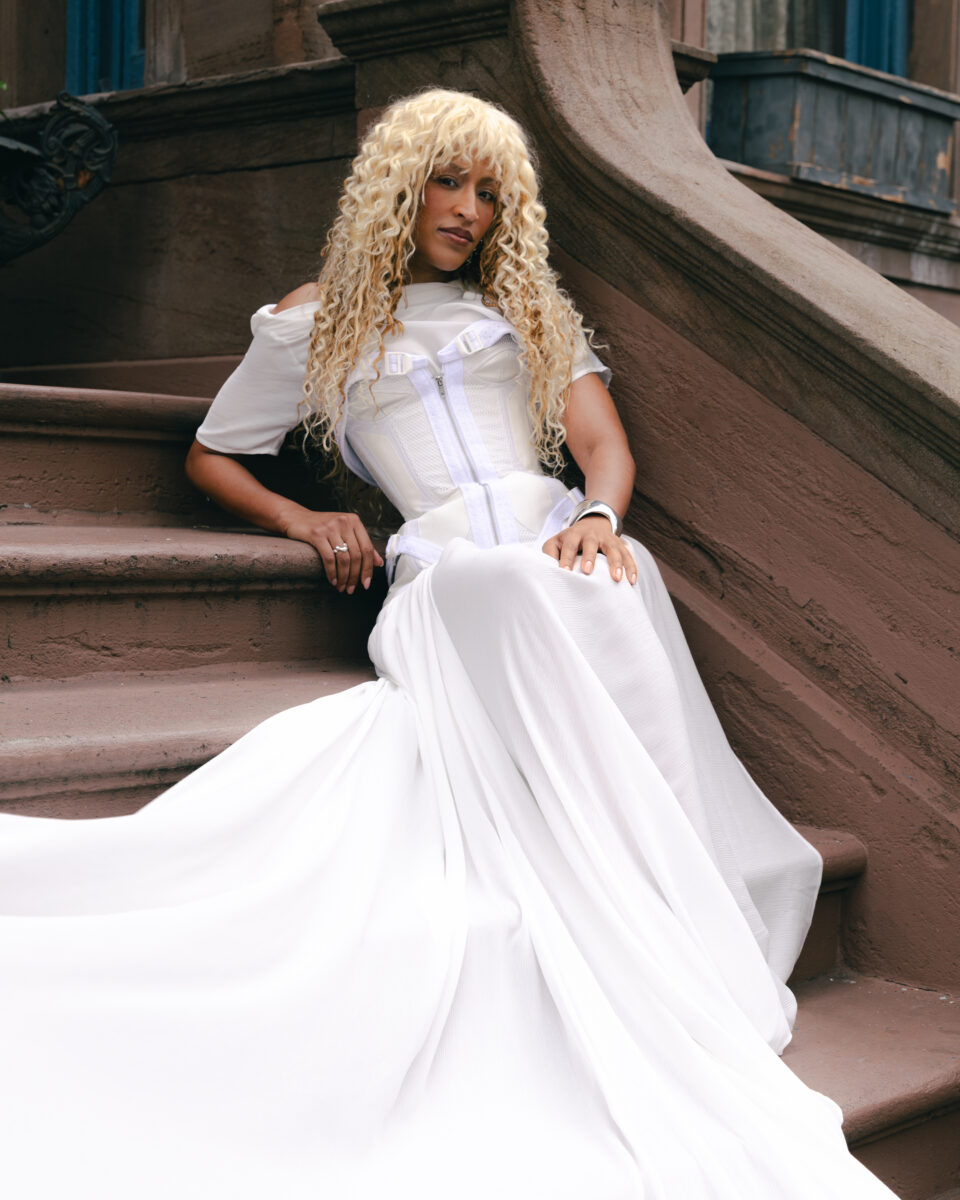
Today, however, Wonderland catches her at the studio she often records at with her producer [David] Sisko, a few days after her cover shoot in New York, an occasion that reminded her of home. “The fact that it was in a brownstone, kind of near where I grew up, in a house that looked like the one I grew up in, and everybody was so creative – the energy was so good,” she says. “From the moment I walked in, you could feel the creativity and excitement.” Like bees feeding off of sticky pollen, as does Sandflower thrive in creatively-charged environments, and it’s safe to say things have always been this way.
The daughter of a rock star performer and a fine artist, ‘industry talk’ was the first real language she learned. “I was lucky to have a head start with my mom being in the record industry and going to meetings with her, and being in sessions with her,” she says. “As a kid, seeing how she spoke to a big round table and a bunch of guys in suits – it’s a little different now, but there’s still remnants of that there, where, ultimately, when you get to a certain level, even with music, every label is a big corporation, and that’s something that I realised when I was signed; that there’s this freedom and creativity that is happening when you’re making the music but when you go into a label situation, there’s an accounting department – the same things that are in any other corporation. That demystifies some of the fantastic elements of music and the music industry.” That firsthand experience – training, really – would ground her first steps into the music world.


A brief but significant surge of attention emerged from this pursuit. Her rendition of the Spice Girls’ “Wannabe” song was a sure hit. After featuring in one of Netflix’s most-watched romcoms, To All The Boys I’ve Ever Loved, featuring faux-lovebirds Noah Centineo and Lana Condor, it struck an electric guitar-plucked-chord with all the tweens, teens, and young adults tugging at the warmth and nostalgia that the movie accommodated. “It turned out that people really liked my songs,” she says, giggling as she caught herself between pride and surprise. “That was really cool, because I love the story of the movie. I love the writing – all of the things that were so important to me were embodied in this opportunity and this project, and it felt really good, because it just showed that even the writer, the actress, the musical director, we’re all on different journeys, but the same path of expressing yourself as somebody, as an outsider, as a woman, as a person of colour.”
Last year, Sandflower released her second album, The Radiant Explorer – the disco-booming, electro-heavy sequel to The Quantum Seed – a body of work that transported fans, listeners, and audiences beyond into a dimension where blues-plucked basses, psychedelic and swirling synths, and punky percussion took over. This is her signature – full-bodied, no restrictions, and an endless, open invitation to her inner world.
It becomes clear in her verbal outpour that intentionality only feeds her inner machinery, sending energy from her mind all the way to her fingertips; music is just the medium in which she allows her audience to experience the fullness of that internal process. “I think about everything in terms of music. With collaboration, I come into it with that same sense of ‘we’re doing this together’,” she says. “I’m not very hierarchical, so when I was talking about expressing myself, it’s because I don’t put myself below or above. No matter who I’m talking to, I’m always going to talk to everybody with respect.”
And even though in Sandflower’s multiverse, she may be the leader now, there are overseers, and they come in the form of “mom and dad.” This endless fountain of wisdom she has to pull from has proved to be a lifeline in the nine lives she’s lived in the industry already. “Knowing the ups and downs and pitfalls that I was even dealing with on the business end…luckily, everything was great,” she hesitates. “I was in a singles deal, and I got out of it because I had great lawyers – all of that was because I was getting advice from my mom and my dad. So I have to say, if I were out here just winging it, I wouldn’t have had the discernment to stay away from some things that unfortunately exist in every industry, honestly.”
Her awareness of the industry’s pitfalls is her quiet superpower – honed, no doubt, by her parents’ wisdom – though she rarely makes a show of it. The point of solitude for her musically is where she’s led emotionally, and that’s where the real beauty (and fun) comes in. “As someone who’s vulnerable because they love their music and they love their art – when people are giving you the ‘we’re gonna do this’, ‘we’re gonna do that’, you have to be able to remove yourself from the excitement.”
Or get over it by thrusting herself into it. This year, she jumped backstage – and onstage – at London Fashion Week with her Sprayground friends, now colleagues, for their debut Spring Summer ‘25 show; their fifth show, following stints in New York City and Milan. With a dream that came to her in 2019 to bridge the brand to the fashion world, fusing her music and fashion background became incessant. With DBD onboard, and “ready to express himself through fashion” but needing a catalyst, they set out to make the fashion show – one of many – happen, and since then the trajectory has been “truly astounding”.
“Creative directing the fashion show at London Fashion Week with DBD (the founder) was such an incredible learning and expanding experience – it’s an aspect of the “show” I really love to concentrate on,” she says excitedly. “He (DBD) is effortless to work with because of the strong female energy in his family – even incorporating his mother into each of the Sprayground Runway shows. He understands how to support fellow creatives’ needs, entertains all ideas and manages bold risks well, and he reinforced my confidence by introducing me to colleagues as the Creative Director of the show.” It was this subtle, but pivotal detail, that affirmed Sandflower’s position, emboldening her to contribute to all aspects of the Fashion Week experience; from sound to vision, casting to set design, and of course, the whole performance.
Her partnership with streetwear brand Sprayground is a collaboration that was predestined. “It was actually a very serendipitous meeting,” she begins, unravelling the story that began in New York, and then to London, and, you could say, ended with this cover in Los Angeles and her as their Creative Director of Content, Runway and Casting. She was in a studio, much like her producer’s studio where she was sitting. This was at the start of her and Sisko working together, when she was bopping between London and New York and still signed to Interscope Records. A mutual friend encouraged her to meet with DBD and his brother Michael, the founder of Sprayground, and it’s cliché, but the rest really was history. In a period where she was deciphering her sound, with the help of Sisko’s mixed-genre musical background and view of music as a more holistic path, she stumbled on a piece of treasure in the wider chest that would illuminate her way to a new creative hunch. “He had a Sprayground bag on one of the studio chairs – it had been there for two days, this little camouflage bag – and I was like, ‘what is that? It’s really cool’,” she says, an excited glimmer in her eye. “Sisko’s friend was working with the guys from Sprayground – it was the beginnings of the company, a few years in – so we met with DBD and Michael, and it really came together. It was just all these creatives who were clearly on a path, no clue where it was gonna go, but you could feel this energy of the trajectory moving up.”
So up they went, reaching great heights together; from short collaborations with legendary hip-hop rapper Wyclef Jean to a debut at London Fashion Week this year – an event that Sandflower still geeks over. “The show kind of sealed the deal,” she says. “I was also performing in the show. When he [DBD] heard the song, “I Can’t Stop”, he was like, ‘I really want you to do this.’ And then, we rearranged the song here, actually, with Sisko. It’s one of my favourite songs, because it’s about not giving up on music – I mean, it could be about not giving up on anything – but in particular, it’s about if you start something with someone, you got to keep doing it, even if that someone is their reflection in the mirror.”
For Sandflower, every project is another experiment in light. A search for what shines, what burns, and what reflects. That curiosity extends beyond sound into art, fashion, and philosophy. Amidst a long list of inspirations spanning the greats: Jimi Hendrix, Prince, Smokey Robinson, Michael Jackson, and Lady Gaga, in this conversation, her mind rests on Jean-Michel Basquiat’s A Radiant Child (2010) documentary, an enriching deep dive into the mind and heart posture behind one of the world’s most renowned artists.
“The thing about radiance is that, a lot of the time, the person who is radiating doesn’t see their radiance. That’s what I took away from the doc,” she expresses. “It’s not easy to be an explorer. It’s not easy to walk through the jungle or the mountains without a discernible path, yet wanting to be part of the jungle, of the mountains, without destroying them. I feel like that with my music: that I am exploring, and I always want to be with everything I do. It’s good to be intellectually and emotionally curious. I want to know things.”
That curiosity is both her compass and her challenge. “You don’t know where you’re necessarily going to end up.” But this gives her the purpose for a mission she intends to be on for a long while: “Even if you’re going down a path that someone else has gone down, it’s still an exploration. You also have to have the confidence to do it, because you could be inspiring someone else.”
Of the memories she’s accumulated while being on this long journey, the ones she’s most excited for, are the ones to come. On her forthcoming five-track EP, The Radiant Expansion, she lunges into that extradition more. Again, with Sisko’s help on this run, it might just be the closest they’ve gotten to time travel. “Making The Radiant Expansion was like playing with an actual time machine,” he says. “Sandflower and I were able to visit her past and introduce the future while creating in the present.” On this part of her musical hike, her past trip to London during fashion week becomes a key marker for the way her art would take shape: “Music is a centrepiece art form in my life, so it also informs me in other ways, visually. I had some specific ideas, after experiencing London in September, and thought I could express these ideas sonically.”
The result forced her forward, challenging her own perception of what her future looked and sounded like. “As much as there’s a forward motion from an original journey, you also learn many things, change directions, speed up, slow down, and then decide how you want to journey back home,” she says. “Staying curious and open to your own radiance in whatever form it may take is the message for this EP – and life generally.”
As she reflects on the chapters behind her and the ones ahead, Sandflower’s tone softens. Not with weary, but with wonder. “I think I’m still discovering what my radiance looks like,” she says. “Maybe we all are.”
Buy Wonderland’s Winter 25 issue now here.
Photography by Elizabeth Wirija
Styling by Lennon Gabriel
Words by Aswan Magumbe
Hair by Roberto Campisi
Make-up by Ryann Carter
Producer Dakota Griffin of 199X New York
Lighting Assistant Santiago Vanegas
Fashion Assistant Haley Mueller
Junior Production Coordinator Sabrina Palko